
Overview
Laser-Induced Forward Transfer (LIFT) is a versatile manufacturing technique and one of the most advanced integrated additive manufacturing approaches compatible with a wide range of materials.
In LIFT, laser radiation is used to transfer and precisely deposit material at user-defined locations with exceptional spatial resolution. By carefully selecting appropriate laser parameters and accounting for the complex laser-to-material interactions involved, the technique can be successfully applied to materials spanning from solid inorganic compounds to very delicate biological samples.
The relatively simple nature of the laser-induced release and transfer process, together with its relative ease of implementation, initially attracted significant interest from the graphics industry, particularly for digital printing applications. As early as 1970, Levene et al. reported the laser-induced transfer of material across an air gap for character printing, graphic recording and marking purposes. LIFT subsequently popularized the use of lasers for the controlled transfer of specific materials from a donor to a receiving substrate, to such an extent that the acronym itself began to be used as a verb — "LIFTing" — to describe the process of transferring a given material or ink using a laser.
The early success of LIFT also led to the development of numerous derivative techniques, all laser-based and identified by distinct acronyms intended to distinguish them from the original method.
Recently, LIFT has gained significant traction in our industry as Digital Manufacturing (4.0, SMART Factory) establishes itself as a transformative production paradigm reshaping the manufacturing landscape at both small and large businesses. The ongoing shift toward increasing digitization is widely regarded as irreversible, with few industrial sectors likely to remain unaffected in the coming years.
Advances in computing power, computer-aided design (CAD) software and serial production technologies have enabled digital manufacturing to drastically shorten the path from concept to realization. This integrated approach offers exceptional flexibility, allowing design modifications to be readily incorporated into final products. As a result, digital manufacturing has been successfully adopted across a diverse range of industries, including electronics, energy harvesting, packaging, decoration, textile manufacturing, medical instrumentation and regenerative medicine.
Principles of LIFT
Laser printing is a very broad term encompassing a variety of additive direct writing techniques whose operation is based on laser-induced material transfer. In these processes, a controlled quantity of material is transferred from a donor system to a receiving substrate through laser irradiation. Pattern formation is achieved by the relative motion of the laser beam with respect to the receiving substrate and, in some cases, the donor layer.
How LIFT works
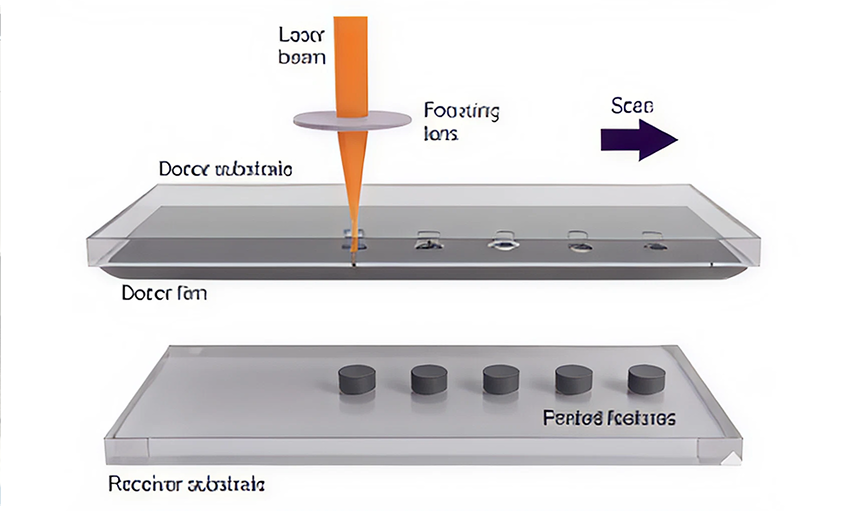
The most widely used laser printing technique is Laser-Induced Forward Transfer (LIFT). In its conventional configuration, the donor system consists of a thin material film coated onto a transparent supporting carrier substrate, and the laser source is typically pulsed.
An optical setup focuses the pulsed laser beam through the transparent supporting substrate onto the back of the donor film.
Upon laser irradiation, a small volume of the donor material is ejected forward toward the receiving substrate, resulting in the formation of a pixel or voxel on the substrate.
By repeating this process at different positions, complex and arbitrary patterns can be produced.
Evolution of use cases
The donor material in LIFT may be either solid or liquid. In the earliest implementations of the technique, dating back to the mid-1960s, the donor material was exclusively solid.
However, significant advancements in recent years have greatly expanded the range of transferable materials. These now include (particle-filled) liquids, biological substances such as DNA, and even entire components, including surface-mounted devices and bare semiconductor dies, all of which can be successfully transferred using LIFT.
Depending on the laser beam characteristics and the material properties, different mechanisms of the laser-induced ejection can occur.
LIFT's future in our industry
The need for assembling more and more complex designs and smaller components is pushing electronic manufacturing techniques beyond their current capabilities.
In particular, traditional approaches to the manufacture of printed circuit boards (PCBs) are not compatible with the needs of a new generation of electronic systems that call for electronic circuits to be conformal, flexible and hybrid in nature.
Conformal circuits are needed to realize electronics in 3D rather than standard planar or 2D configurations — a requirement that is becoming more urgent as 3D printed electronics mature and become more reliable.
Flexible circuits require the integration of components into substrates or packages that are mechanically compliant, so that they can conform, bend, stretch or fold to a predesigned level without causing the circuit to fail.
Hybrid circuits are comprised of distinct discrete components integrated into single or multilayer architectures assembled on non-traditional substrates, as opposed to printed circuit boards. Examples of such components include logic, communication, memory, sensing and power elements, all integrated into a functional system or module.
The need for new fabrication techniques like LIFT, capable of producing and assembling these new types of circuits, cannot be ignored.
LIFT in surface mount assembly today
One of the largest potentials for this technology has long been recognized as the deposition of solder paste in accurate and repeatable volumes for the full range of components — from 01005s through power components to huge BGAs with 3,000 or more micro balls. All having demands which challenge or exceed existing manufacturing capabilities.
.png?width=845&height=685&name=Frame%20(1).png)
The 'solder paste' challenge
LIFT has always struggled to successfully transfer solder paste, as it is actually a very complex material made up of spheres of a metal alloy of controlled size distribution, flux chemistry, activators (e.g. organic acids, halides) which are responsible for chemical cleaning, and are contained in vehicles (e.g. resins, synthetic polymers), rheology modifiers, solvents, and various specialized additives.
These ingredients, though often present in very small percentages, dictate critical physical properties of the paste, such as its viscosity, tackiness, stability and printing characteristics. Without them, even the best solder powder and flux combination would be unworkable in an SMT production environment.
So, any damage to these constituents or even very small changes in the amounts will affect paste performance.
Solder paste unlocked
In recent years, many clever people have tried to crack the code of solder paste printing using LIFT and have failed to end up with a robust and industrially integrated process. But a few years ago, TNO Research, a Dutch research institute that holds several patents on LIFT for (micro)electronics and semicon, was instrumental in setting up Keiron Printing Technologies, in 2019, to commercialize this advanced technology.
To date, Keiron has filed 11 patent families and more are being prepared, all relating to the new knowledge needed to successfully use LIFT technology to print solder paste in an industrially implementable way.
This LIFT-based platform addresses the print-related issues of our industry head-on. By using an ultra-high-resolution laser to transfer very precise volumes of solder paste from a donor carrier plate directly onto the PCB pads, at very high speed, the system delivers much improved volumetric control with no satellites or bridging.
Supporting and tested on a range of standard Type 5 solder pastes, the solution avoids the high costs associated with (qualifying) specialized pastes and significantly simplifies supply chain logistics.
Keiron: digital, efficient, and sustainable
The digital nature of the platform brings several operational advantages: programming can be completed in under 15 minutes using Gerber or ODB++ files, reducing setup times by up to 90%.
Moreover, by eliminating the need for other machines, stencils and alignment tooling, capital investments for capacity scaling can be reduced by over 60%.
From a sustainability perspective, the solution cuts energy and chemicals usage, and generates minimal waste.
These environmental benefits, combined with the system's software-driven control and its very repeatable high-accuracy deposits, make it highly appealing to forward-looking companies in the prototyping, NPI, and all high-reliability market places.
About the author
Keith is a fully qualified engineer with over 35 years of experience in electronics manufacturing. He is widely respected for presenting technical papers at international industry events and for his many published articles and interviews.
His career spans bare PCB technology, contract manufacturing, advanced materials and soldering systems, and high-technology X-ray and AOI inspection systems. After serving as Global Sales Director of a leading X-ray manufacturer (2017–2019), he returned to independent consultancy in 2020, supporting multinational companies on advanced manufacturing and Industry 4.0 projects.
Keith served as Chairman of the SMART Group for 11 years and is currently Chairman of SMTA Europe. In 2018, he received the SMTA International Leadership Award.
Acknowledgments: Piqué, A. & Serra, P., Laser Printing of Functional Materials: 3D Microfabrication, Electronics and Biomedicine, 2018.